
ZAP Review Game
This blog post contains Amazon affiliate links. As an Amazon Associate, I earn a small commission from qualifying purchases.
ZAP is a fun and competitive review game structure that can be used with any subject and any set of questions.

Why ZAP?
When I started teaching at my current school, I found that a lot of my go-to review games from my first six years of teaching just didn’t work with new class sizes of 25-30 students. The first game that I was able to successfully use with these new larger class sizes was ZAP.
ZAP has become one of my students’ most requested review games. Whenever one class gets to play it and another doesn’t, I definitely hear complaints. Let me teach you how to play and share some tips/tweaks I have made along the way.
The main idea behind the game of ZAP is that students answer questions. Correct answers earn you points and give you a chance of pulling a ZAP card.
The ZAP cards can help your team’s score, hurt your team’s score, help the other teams’ scores, or hurt the other teams’ scores.
This adds fun and unpredictability to the game which keeps the activity interesting. I also like that this game structure means the team that is academically the strongest doesn’t automatically win.
Prepping Your ZAP Cards
If I remember correctly, I first ran across ZAP as a game for 2 teams while browsing Pinterest. The game featured cards that were held in library pockets. As you will see from my photos, I have adapted this game over the years to work with multiple teams. I have my students seated at 6 tables, so we usually play this game with 5-6 teams.

The ZAP cards that I use in my classroom are handwritten cards with marker on thick blank cards that I picked up at a garage sale when I first started teaching.
(In the picture below, you will see an older version of my ZAP cards that say “subtract 3 points” or “add 2 points.” At a certain point, I changed my point structure for this game and changed this to “subtract 30 points” and “add 20 points.”


Once you prep your ZAP cards, the only real prep is to find a set of questions to use for the review game. If you want to steal my ZAP cards, I have uploaded them as a free printable file at the end of this post.
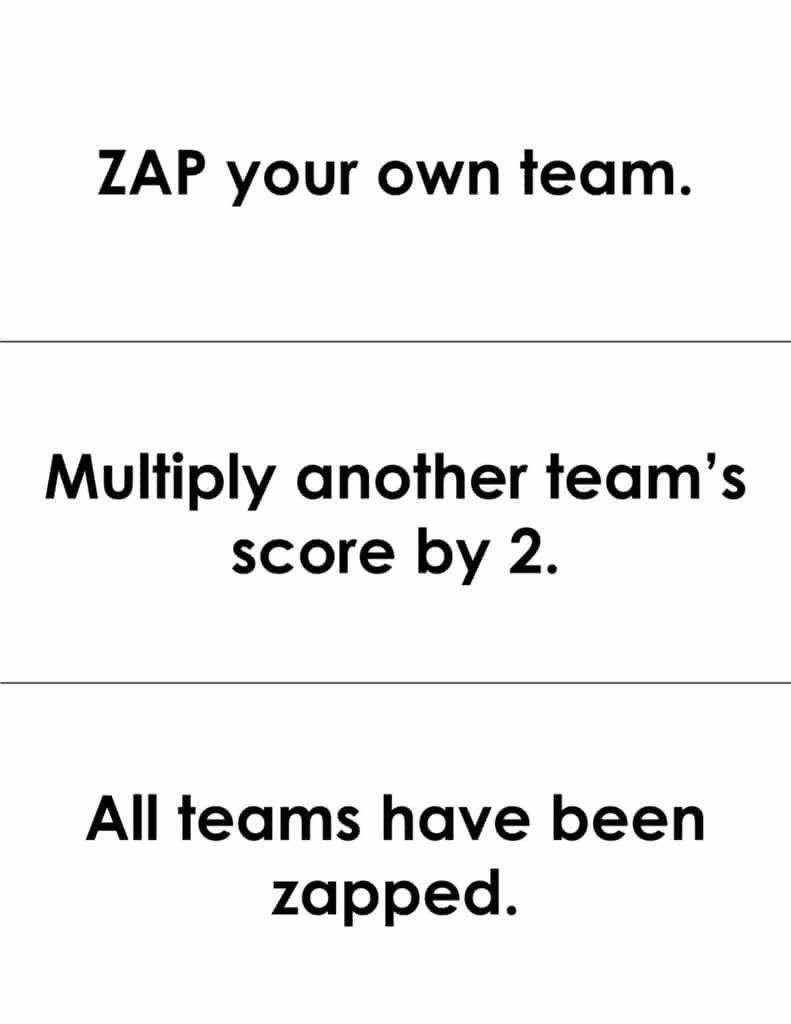
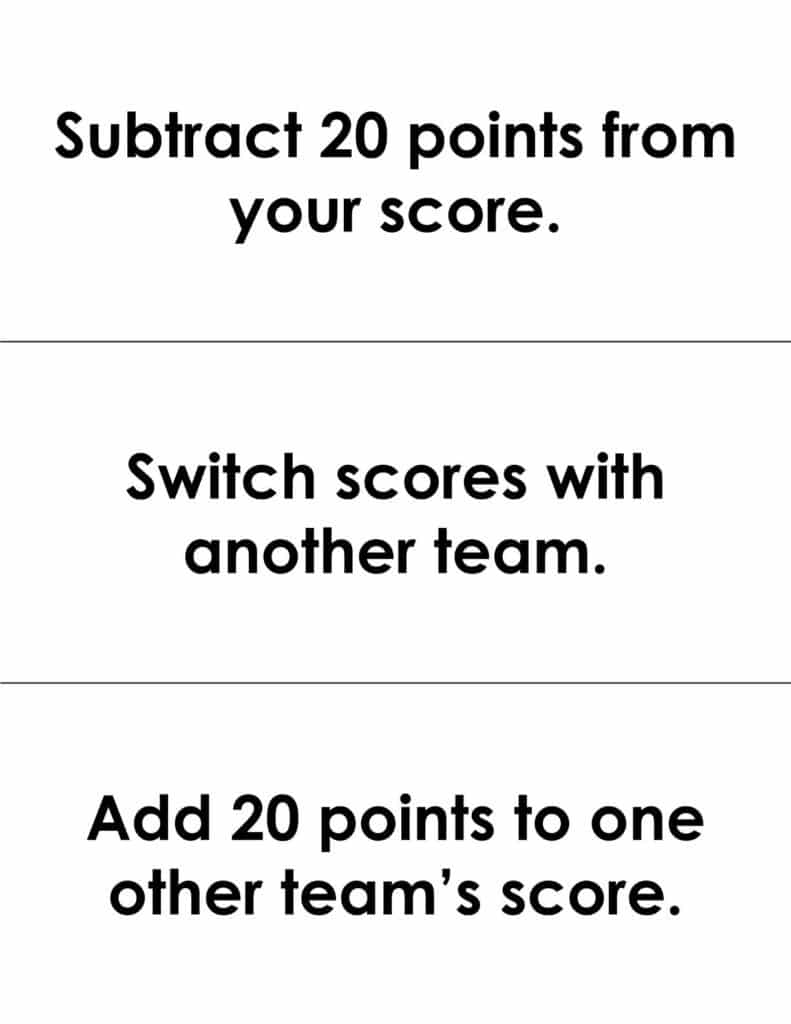
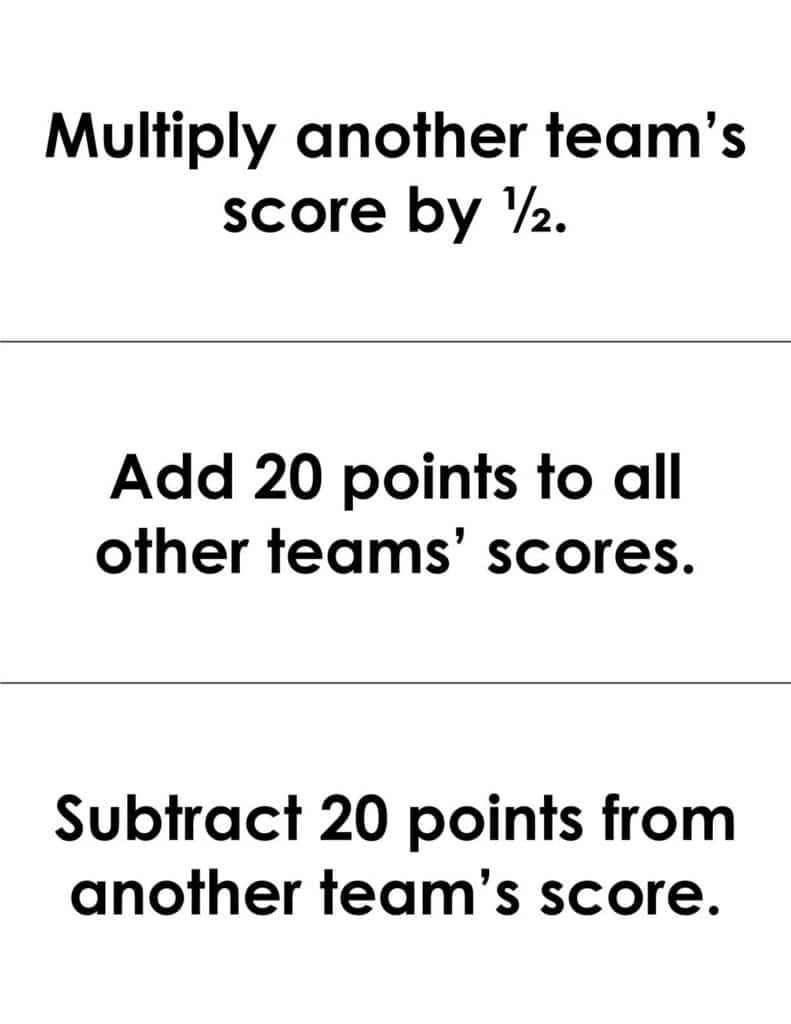
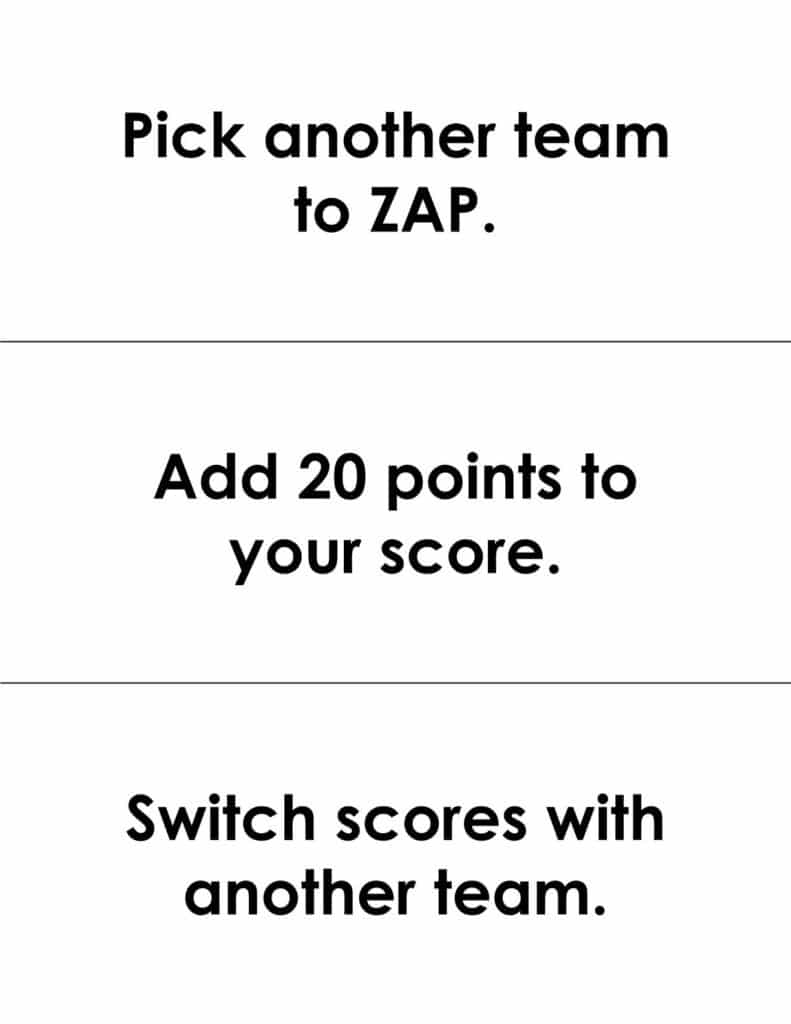

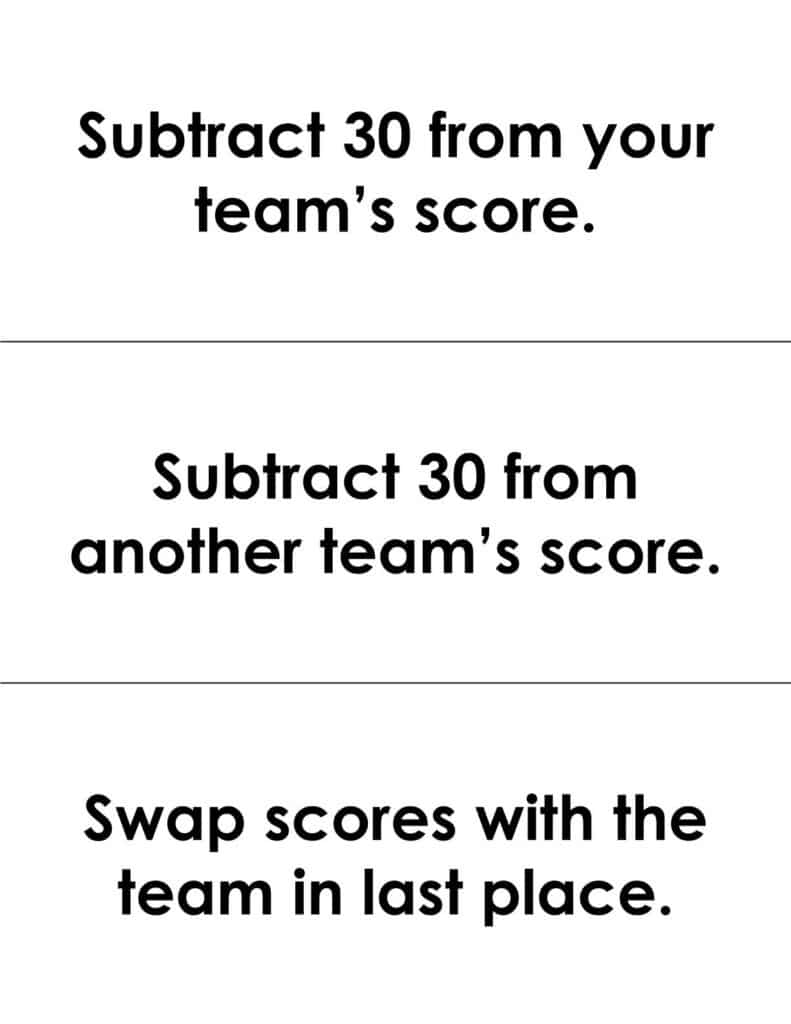
These cards are designed to be printed double-sided on colored cardstock. The word ZAP will print on the back of the cards to help prevent students from “seeing” through the cards to read the message on the other side.
Prepping Your Questions and Board
You can use this review game with any set of questions for any topic in any subject. You just need a set of questions and answers.
In my own classroom, I typically use this game with multiple choice AP questions for AP Precalculus and AP Calculus that I have sourced from College Board’s AP Classroom website.
Since I typically use this game with multiple choice questions, I set up my dry erase board with mini magnetic pockets for groups to place their multiple choice letter cards in when submitting their answer.
Groups initially put their letter cards backwards when submitting their answers. Then I turn them around one at a time for a grand reveal.
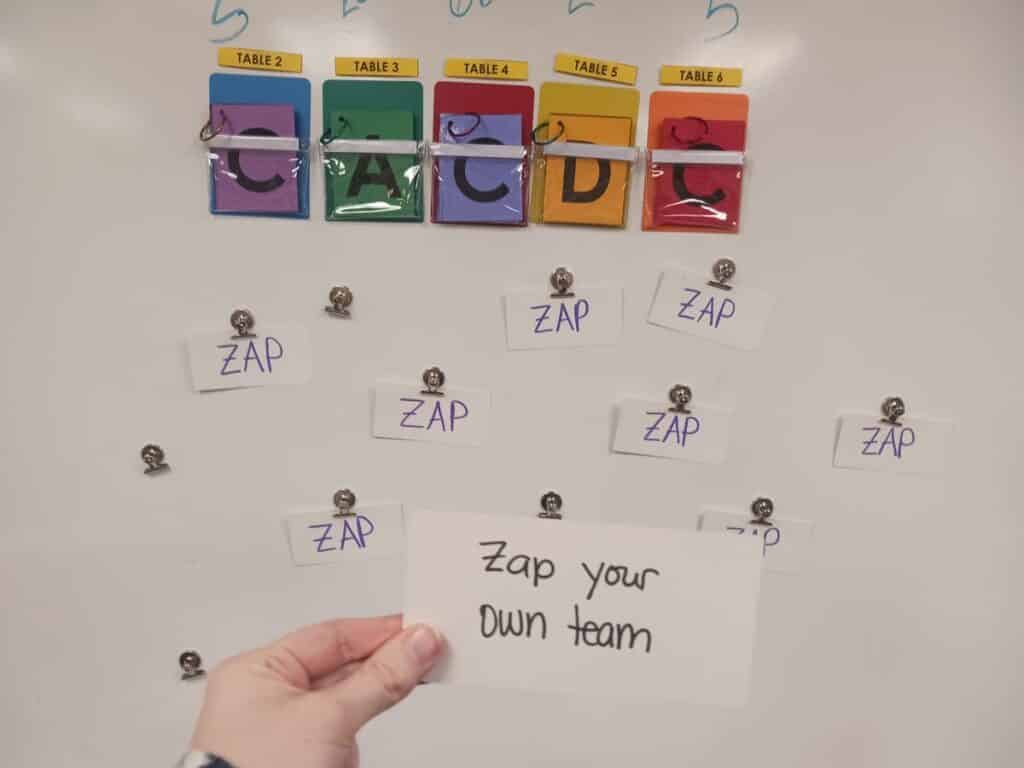
I also use magnetic clips to hang all of the ZAP cards on the board with the ZAP side facing outward.
Running the Review Game
Split students into teams. I have 6 tables in my math classroom, so I usually have 4-6 teams based on that particular hour’s class size.
Present a question. Give each team an opportunity to answer. This could be through the multiple choice letter cards I shared in another post or by having groups write their answer on an individual dry erase board and hold it up. Use whatever method works best for you and your students.
Reveal the answer and go over the question if needed.
Award 10 points to each team who answered the question correctly.
Choose one of the teams who answered correctly to choose a ZAP card.
There are several ways to do this that I have used over the years. I have popsicle sticks with each team number written on it. Put the popsicle sticks for the correct teams in a cup and pull a stick.
I have 6 tables and a max of 6 teams, so I have also used rolling a die to generate a team number. Sometimes this results in rolling a ridiculous amount of times to land on a number that matches a team that actually answered correctly.
Recently, I added a giant magnetic spinning wheel to my classroom thanks to some grant money. (Full disclosure – the magnetic spinning wheel is pricey, and I don’t think I would spend my own personal money on it. The magnet will also only stick to one of my 3 dry erase boards. It sticks to the other 2 dry erase boards, but it slowly slides down the board which kind of defeats the purpose. Buyer be warned!)
I ended up making a custom spinner insert with the numbers 1-6. My students absolutely love spinning the wheel to determine which team is going to pick the ZAP card. If only 2 teams answer correctly, I have them choose evens vs odds before we spin to get rid of the problem I mentioned earlier with the dice and continually getting numbers of teams that did not answer correctly.
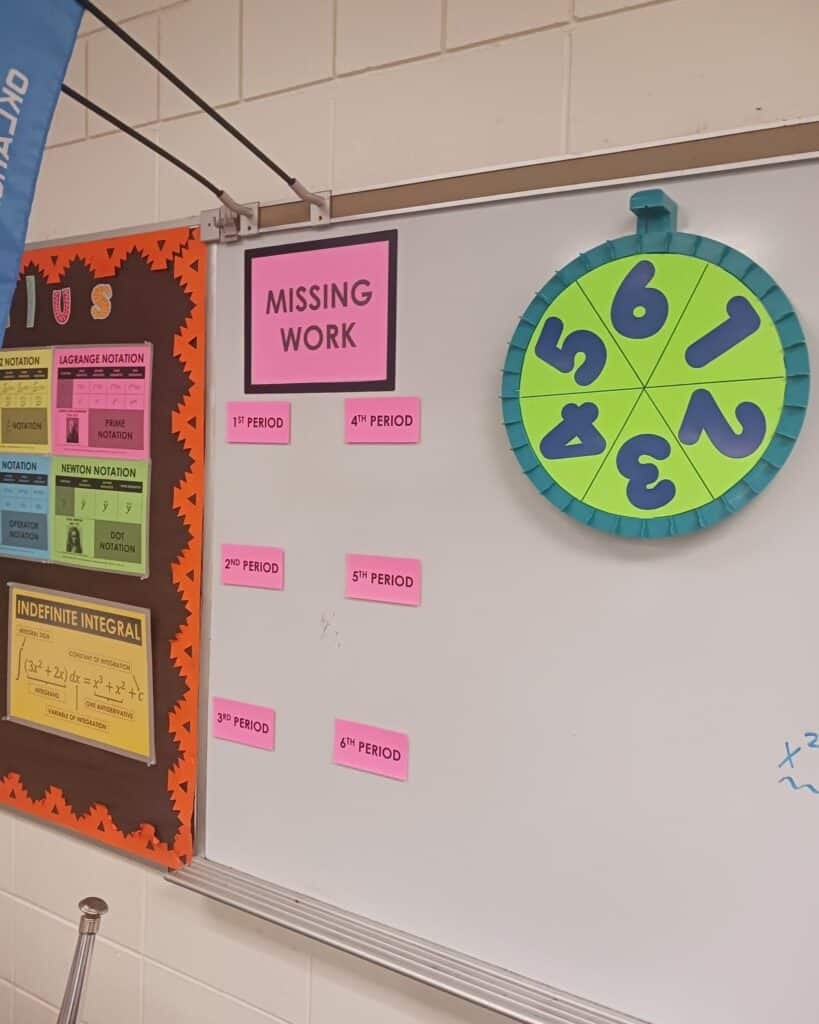
If only one team answered correctly that team automatically gets to pick the ZAP card.
The chosen team draws a ZAP card. I have them clipped magnetically to the board. I find it hysterical how much time groups will spend deliberating which card they should pick. You could also just fan the cards out and have a student grab one.
Follow the instructions written on the card. Most of the cards are pretty self-explanatory. They usually involve adding points to a score, subtracting points, multiplying by a number, or switching scores with another team.
If a team gets zapped, their score goes to 0. If all the teams get zapped, everyone’s score goes to 0. Depending on when in the game this happens, this can lead to a very vocal response from the students.
Repeat this process with a new question.
Continue as long as time allows or you run out of questions or ZAP cards. The team with the most points at the end wins! I award Carter Cash to the winning team. Carter Cash can be redeemed for 15% extra credit on a quiz or 5% extra credit on a test.
Other Variants of ZAP
- – 5th Grade Rocks 5th Grade Rules ZAP Review Game – Features cards in library sleeves. Designed for 2 teams.
- – Dissonant Symphony ZAP Review Game – Similar to 5th Grade Rocks 5th Grade Rules – Has an optional way to play where points are not given, but teams pull cards to perform crazy actions like “Crab Walk Back to Your Desk.”
- – Free Printable ZAP Cards from Free to Teach on Teachers Pay Teachers
Files
These ZAP review game cards are available as a PDF file and an editable PPT file. In order to edit the PowerPoint file, you will need to first unzip the file.
Zap Review Game Cards (PDF)
728 saves – 39.54 KB
PPT (in ZIP)
Click here to SAVE the file to your device.Zap Review Game Cards (PPT in ZIP)
150 saves – 72.39 KB
Hello! Do you have another post where you kind of explain how to use this? I’m interested to try it, but I’m not seeing how it’s played? Thank you!
I really need to write a blog post about this. Until then, here are some blog posts I read when I was learning about the game. Every teacher plays slightly differently, but hopefully this will give you enough inspiration to make a version for your own classroom.
https://www.highheelsandnumber2pencils.com/2021/04/zap-best-review-game-ever.html
http://5thgraderocks5thgraderules.blogspot.com/2012/02/zap.html
http://8ismyluckynumber.blogspot.com/2013/03/zap-review-game.html
http://www.livinglaughingandloving.com/2012/08/zap-student-review-game-fave.html